







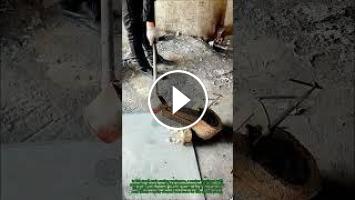
“Melt, mold, make—casting turns liquid metal into solid purpose.” In this small-scale casting workspace, a worker (equipped with protective gloves to avoid high-temperature burns) holds a ladle filled with molten metal, carefully positioning it over a simple mold (likely a cavity-shaped form made for this specific piece). The process unfolding here follows a timeless casting principle: first, a metal material is heated until it turns into a liquid (hot enough to flow smoothly), then this liquid is poured into the mold’s empty space. As the molten metal cools down, it hardens, taking on the exact shape of the mold’s interior—this is how raw metal is transformed into a functional, shaped piece.
The end result of this careful work will be a solid metal component: once the metal fully cools and sets, the worker can remove it from the mold, and (if needed) smooth its edges to finish the piece. This component might serve as a part of a small tool, a custom hardware fitting, or a decorative metal accent. This matters because small-scale casting is an accessible way to create custom metal parts—unlike mass-produced items, which are limited to standard shapes, casting lets makers craft pieces tailored to specific needs, even for small projects or repairs. It’s also a link to traditional metalworking skills, keeping a practical, age-old craft relevant for modern DIY and small workshop use.
This moment also prompts a key reflection: while casting looks straightforward, it requires careful attention to safety (like the protective gloves here) and precision. Molten metal is extremely hot, so even small mistakes (like a wobbly pour) can lead to burns or flawed pieces. It’s a reminder that working with high-temperature materials balances creativity with caution—you can’t rush the process, and protecting yourself is just as important as shaping the metal. Additionally, small-scale casting shows that you don’t need massive industrial machines to work with metal; with basic tools and care, you can turn a pile of raw metal into a useful object.
In the end, this isn’t just pouring liquid metal into a mold; it’s a blend of traditional craft and practical problem-solving. Every steady movement of the ladle, every properly shaped mold, and every focus on safety turns a hot, flowing material into a solid, functional piece—proving that casting is as much about care and skill as it is about transforming metal.
The end result of this careful work will be a solid metal component: once the metal fully cools and sets, the worker can remove it from the mold, and (if needed) smooth its edges to finish the piece. This component might serve as a part of a small tool, a custom hardware fitting, or a decorative metal accent. This matters because small-scale casting is an accessible way to create custom metal parts—unlike mass-produced items, which are limited to standard shapes, casting lets makers craft pieces tailored to specific needs, even for small projects or repairs. It’s also a link to traditional metalworking skills, keeping a practical, age-old craft relevant for modern DIY and small workshop use.
This moment also prompts a key reflection: while casting looks straightforward, it requires careful attention to safety (like the protective gloves here) and precision. Molten metal is extremely hot, so even small mistakes (like a wobbly pour) can lead to burns or flawed pieces. It’s a reminder that working with high-temperature materials balances creativity with caution—you can’t rush the process, and protecting yourself is just as important as shaping the metal. Additionally, small-scale casting shows that you don’t need massive industrial machines to work with metal; with basic tools and care, you can turn a pile of raw metal into a useful object.
In the end, this isn’t just pouring liquid metal into a mold; it’s a blend of traditional craft and practical problem-solving. Every steady movement of the ladle, every properly shaped mold, and every focus on safety turns a hot, flowing material into a solid, functional piece—proving that casting is as much about care and skill as it is about transforming metal.
- Catégories
- prompts ia
Ajouter un commentaire
Up Next
Autoplay
-
00:50

Why Bringing AI To Your Business Might Be a HUGE Mistake #shorts #ai #podcast #business #process
-
01:00
Un film Dragon Ball Z avec un casting de malade. Imaginez si ça se fait ? #dbz #IA #fancast #theorie
-
00:09
#ai #aiart #power #metal #ironmaiden -????:This katana shall be unsheathed, and with it, all shall e
-
00:15
When haces tus momos en videos (tubo de metal IA)
-
00:13
She’s Metal, But She Loves Like Mom #robot #humanoid #athlete #mother #aiart
-
00:46

TOP 5 OUTILS D'INTELLIGENCE ARTIFICIELLE POUR TON BUSINESS
-
26:08

E-Commerce: Comment faire 600€ par jour avec l'IA & ChatGPT (11 Stratégies)
-
15:15

Les 5 MEILLEURES IDÉES de business à lancer avec l’INTELLIGENCE ARTIFICIELLE (Open AI et Chat GPT)
-
08:19

10 idées de business en ligne pour 2023 - 2024 avec l'Intelligence Artificielle
-
38:09

UNE MINE D'OR: 7 Business D'Intelligence Artificielle pour générer des PROFITS MAINTENANT
Commentaires