







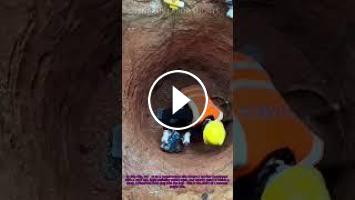
“Good foundations are dug, not just built—every inch of depth adds to a structure’s strength.” In this clip, we’re at a construction site where a worker (equipped with a hard hat, high-visibility safety vest, and sturdy gear) is inside a deep, cylindrical hole dug into the soil—this is the start of a manual auger pile. The worker uses a handheld digging tool to scrape and remove soil from the bottom and walls of the hole, while overhead equipment (visible at the top of the hole) stands ready to lift the excavated soil out safely. The process here is deliberate: each scoop of soil is removed carefully to keep the hole’s walls stable, and the worker’s protective gear is non-negotiable given the enclosed, deep workspace.
This method relies on a simple, reliable principle: manual auger piles are dug by hand to create precise, deep holes, which are later filled with reinforced concrete to form load-bearing “legs” for buildings. These piles transfer the structure’s weight from the surface down to deeper, more stable soil layers—layers that can support heavy loads without shifting or settling. Unlike large mechanical digging tools, manual excavation lets workers adjust the hole’s shape and depth to match the site’s unique soil conditions, making it a practical choice for tight spaces or uneven terrain where machinery can’t operate.
Once the hole reaches the required depth, it will be fitted with steel rebar and filled with concrete. When the concrete hardens, it becomes a sturdy pile that anchors the building to the stable soil below. The result is a firm, stable base that prevents the structure from sinking or sustaining structural damage over time.
This work is critical because a building’s safety depends entirely on its foundation. Manual auger piles fill a key niche in construction: they’re accessible for small-to-medium projects and adaptable to tricky sites, ensuring even constrained areas can support safe, durable structures. Cutting corners on this process—skimping on depth or ignoring soil conditions—would put the entire building at risk later, so every careful scoop of soil here is an investment in long-term stability.
This scene also prompts a small reflection: while modern construction leans on heavy machinery, manual methods still matter for their flexibility and precision. But this work carries clear risks—deep holes can collapse, and enclosed spaces pose hazards—so the worker’s full safety gear (and overhead support tools) is non-negotiable. Efficiency should never come at the cost of well-being.
In the end, this isn’t just digging a hole; it’s laying the literal groundwork for a safe, lasting structure. Every careful scrape, every piece of protective gear, and every inch of depth dug brings the building one step closer to standing strong—proving that even basic foundation work is a vital, thoughtful part of building something that lasts.
This method relies on a simple, reliable principle: manual auger piles are dug by hand to create precise, deep holes, which are later filled with reinforced concrete to form load-bearing “legs” for buildings. These piles transfer the structure’s weight from the surface down to deeper, more stable soil layers—layers that can support heavy loads without shifting or settling. Unlike large mechanical digging tools, manual excavation lets workers adjust the hole’s shape and depth to match the site’s unique soil conditions, making it a practical choice for tight spaces or uneven terrain where machinery can’t operate.
Once the hole reaches the required depth, it will be fitted with steel rebar and filled with concrete. When the concrete hardens, it becomes a sturdy pile that anchors the building to the stable soil below. The result is a firm, stable base that prevents the structure from sinking or sustaining structural damage over time.
This work is critical because a building’s safety depends entirely on its foundation. Manual auger piles fill a key niche in construction: they’re accessible for small-to-medium projects and adaptable to tricky sites, ensuring even constrained areas can support safe, durable structures. Cutting corners on this process—skimping on depth or ignoring soil conditions—would put the entire building at risk later, so every careful scoop of soil here is an investment in long-term stability.
This scene also prompts a small reflection: while modern construction leans on heavy machinery, manual methods still matter for their flexibility and precision. But this work carries clear risks—deep holes can collapse, and enclosed spaces pose hazards—so the worker’s full safety gear (and overhead support tools) is non-negotiable. Efficiency should never come at the cost of well-being.
In the end, this isn’t just digging a hole; it’s laying the literal groundwork for a safe, lasting structure. Every careful scrape, every piece of protective gear, and every inch of depth dug brings the building one step closer to standing strong—proving that even basic foundation work is a vital, thoughtful part of building something that lasts.
- Catégories
- prompts ia
Ajouter un commentaire
Up Next
Autoplay
-
08:00

Trading Manual vs. Automático con IA ???? Resultados REALES I3Q (5 meses)
-
28:16
Get a Clue Pile of Possibilities | Will I guess the prompts correctly?
-
15:20
????Digging into IA SOLALT's Top Pick #2! ????
-
00:55
Evolução da Agricultura: Do Trabalho Manual à IA
-
00:37
AI vs. Manual: Navigating the Future of Tech Development
-
00:46

TOP 5 OUTILS D'INTELLIGENCE ARTIFICIELLE POUR TON BUSINESS
-
26:08

E-Commerce: Comment faire 600€ par jour avec l'IA & ChatGPT (11 Stratégies)
-
15:15

Les 5 MEILLEURES IDÉES de business à lancer avec l’INTELLIGENCE ARTIFICIELLE (Open AI et Chat GPT)
-
08:19

10 idées de business en ligne pour 2023 - 2024 avec l'Intelligence Artificielle
-
38:09

UNE MINE D'OR: 7 Business D'Intelligence Artificielle pour générer des PROFITS MAINTENANT
Commentaires