







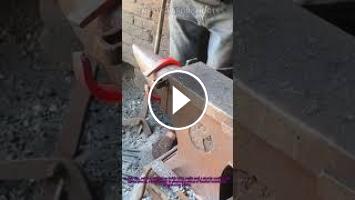
“Good tools are forged, not just made—craftsmanship turns metal into reliable helpers.” In this clip, set in a workshop (with brick walls and a sturdy anvil as the centerpiece), a blacksmith is shaping a piece of heated metal into round-nose pliers. The smith holds the glowing metal on the anvil with a tong, striking it repeatedly with a hammer to bend and mold the material; between strikes, they adjust the metal’s position to refine the curved jaw of the pliers. The method here relies on a basic property of metal: when heated to high temperatures, it becomes more flexible, letting the smith reshape it with controlled force, and each strike also helps compact the metal’s structure, making the finished tool harder and more durable.
What this process creates is a pair of round-nose pliers designed to grip curved or cylindrical objects—like pipes, metal rods, or small rounded workpieces—without slipping. Unlike mass-produced pliers that follow standard sizes, this hand-forged version can be tailored to the smith’s specific needs (whether a wider jaw for larger pipes or a finer curve for delicate work). This matters because specialized tools make tasks safer and more efficient: a well-fitted round-nose plier reduces the chance of dropping workpieces (which could cause accidents or damage materials) and cuts down on the effort needed to hold objects steady.
This moment also prompts a small reflection: while factory-made tools are widely available, hand forging keeps alive a skill that prioritizes customization and attention to detail. Every strike of the hammer is a choice about the tool’s shape, strength, and function—something that can’t be replicated by assembly lines. For small workshops or artisans, these handcrafted tools aren’t just replacements for store-bought ones; they’re extensions of their craft, built to fit their unique way of working.
In the end, this isn’t just hitting metal with a hammer; it’s a deliberate, skillful process of turning raw material into a tool that will serve its purpose reliably. Every adjustment, every well-placed strike, and every focus on the plier’s curved jaw turns a piece of heated metal into a practical, long-lasting helper—proving that the art of forging is as much about utility as it is about craftsmanship.
What this process creates is a pair of round-nose pliers designed to grip curved or cylindrical objects—like pipes, metal rods, or small rounded workpieces—without slipping. Unlike mass-produced pliers that follow standard sizes, this hand-forged version can be tailored to the smith’s specific needs (whether a wider jaw for larger pipes or a finer curve for delicate work). This matters because specialized tools make tasks safer and more efficient: a well-fitted round-nose plier reduces the chance of dropping workpieces (which could cause accidents or damage materials) and cuts down on the effort needed to hold objects steady.
This moment also prompts a small reflection: while factory-made tools are widely available, hand forging keeps alive a skill that prioritizes customization and attention to detail. Every strike of the hammer is a choice about the tool’s shape, strength, and function—something that can’t be replicated by assembly lines. For small workshops or artisans, these handcrafted tools aren’t just replacements for store-bought ones; they’re extensions of their craft, built to fit their unique way of working.
In the end, this isn’t just hitting metal with a hammer; it’s a deliberate, skillful process of turning raw material into a tool that will serve its purpose reliably. Every adjustment, every well-placed strike, and every focus on the plier’s curved jaw turns a piece of heated metal into a practical, long-lasting helper—proving that the art of forging is as much about utility as it is about craftsmanship.
- Catégories
- prompts ia
Ajouter un commentaire
Up Next
Autoplay
-
07:53

KOOKY SEW-A-LONG - prompt for December and round up reel for November
-
00:42
Apple Drops Out of OpenAI Funding Round Despite ChatGPT Integration
-
00:06
EU NO ROUND 6 #ia #viral #humor #shorts
-
00:36
Red nose “6” Ai #satisfyingvideo #aiart #funny #aigeneratedart
-
02:29
Ki Program ia lehkai mynta ka meit ha ka Euro Round 16 ki khana ka Portugal #france
-
00:46

TOP 5 OUTILS D'INTELLIGENCE ARTIFICIELLE POUR TON BUSINESS
-
26:08

E-Commerce: Comment faire 600€ par jour avec l'IA & ChatGPT (11 Stratégies)
-
15:15

Les 5 MEILLEURES IDÉES de business à lancer avec l’INTELLIGENCE ARTIFICIELLE (Open AI et Chat GPT)
-
08:19

10 idées de business en ligne pour 2023 - 2024 avec l'Intelligence Artificielle
-
38:09

UNE MINE D'OR: 7 Business D'Intelligence Artificielle pour générer des PROFITS MAINTENANT
Commentaires